


Liquefaction Potential Index
The Liquefaction Potential Index (LPI) is an indicator of the risk of liquefaction throughout the entire geological profile.
While the factor of safety (FS) evaluates only a specific soil layer at a given depth, the LPI assesses the overall potential impact on the ground surface and the supported structure, taking into account both the depth and thickness of the soil layer.
The LPI is determined by integrating the contribution of individual soil layers to a depth of 20 m:
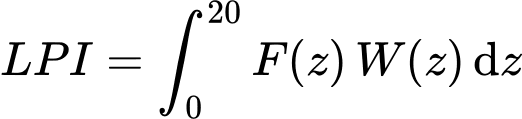
where W(z) is the weighting function accounting for the effect of depth, and F(z) is the liquefaction potential factor:


where: | FS | - | |
z | - | depth at which the LPI is determined |
The following indicative classification can be used for interpretation:
- 0-5 | low
- 5-15 | high
- > 15 | very high
Sources:
Iwasaki, T., Arakawa, T., Tokida, K. (1982). Simplified procedures for assessing soil liquefaction during earthquakes. Proceedings of the Conference on Soil Dynamics and Earthquake Engineering